In this series of Project Journals, we present the technologies we are investigating as part of a toolkit for rapid response to climate-related incidents and disasters. In the previous journal, we talked about LoRa and Meshtastic, and how small messages can travel through a radio mesh without depending on the internet or mobile phone towers. In this journal, we return to an older, and for that very reason more battle-tested, technology: voice radio, in its three forms of use in Brazil — unlicensed, CB, and amateur radio.
Why does radio come first?
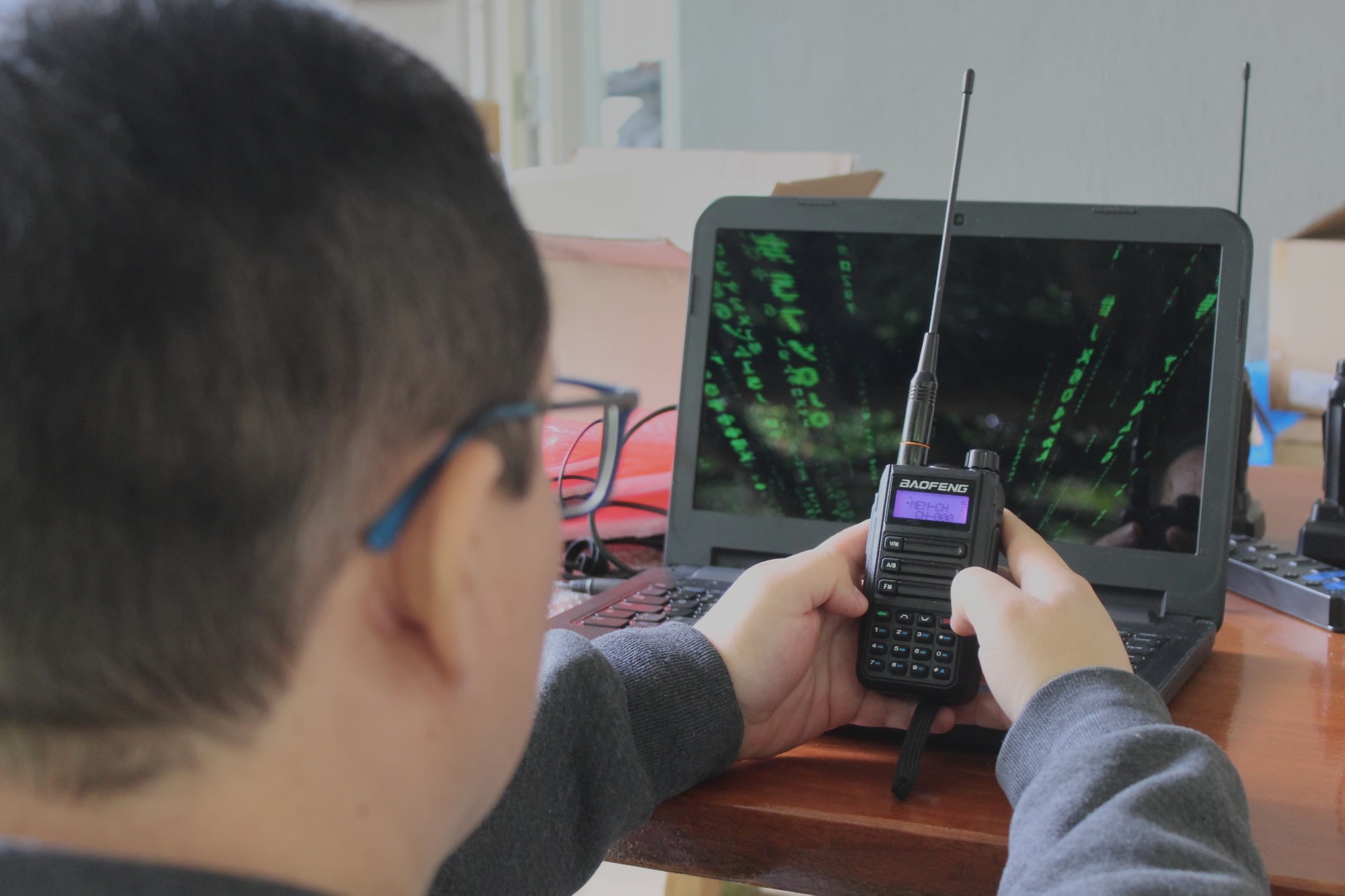
When power, telephony, and the internet all go down at once, voice radio tends to keep working. It depends only on a battery, an antenna, and line of sight between the person transmitting and the person receiving, with no intermediate infrastructure required.
During the 2024 floods in Rio Grande do Sul, this made a concrete difference: amateur radio operators relayed more than four thousand distress calls in the first days of the crisis, and in Muçum, HT Radio sets linked to repeaters were, for a period, the only fully functional means of communication in the city.
That is why, in the communication plan Tridecs has been designing, organized around the PACE model, voice over VHF/UHF occupies the primary layer. LoRa and Meshtastic, discussed in the previous journal, serve as the alternate; Wi-Fi combined with satellite links works as the contingency; and the SOS button on a dedicated tracker is the emergency layer, triggered when the others stop responding.
The three categories of radio
In Brazil, using a voice radio to communicate means choosing among three categories, each with a different balance between ease of use, range, and regulatory requirements.
| Category | Band | What it takes to operate | Range observed (Serra/RS) | Role at Tridecs |
|---|---|---|---|---|
| Unlicensed (walkie-talkie) | UHF, fixed channels | Type-approved radio; no registration | 50 to 700 m | Community and leaders at forward posts |
| CB Radio (PX) | 26.960 to 27.860 MHz (HF) | Free registration in Mosaico + type-approved radio | Depends on antenna and propagation | Base station; contact with highways and truckers |
| PY (Amateur Radio Prefix) | Several bands, from HF to microwave (2 m, 70 cm, etc.) | COER certificate + station license | Kilometers; tens of kilometers with a repeater | Strategic coordination and emergency networks |
The ranges in this table come from the project’s phase 1 field tests, carried out in rugged terrain. They vary considerably with antenna height, vegetation, and obstacles between points.
Unlicensed radios (walkie-talkies)
These are the devices most familiar to the general public: the walkie-talkies used on camping trips, hikes, events, and in the daily work of security and logistics teams. Brands like Motorola Talkabout, Intelbras, and Philips are common examples of this type of radio.
They are the entry point for voice communication: pre-set channels, simple pairing, and no registration required. Anyone in the community can learn to use one in a few minutes, which is why Tridecs distributes them to leaders at forward posts.
The limit lies in short range and the type-approval rule: only radios type-approved by Anatel for these frequencies may transmit on them. Programming an amateur radio, such as the popular Baofeng sets, to operate on unlicensed channels works technically, but is not allowed.
In the most recent generation of this equipment, a few features make a real difference in the field:
- IP65 / IP68 certification, against immersion and dust;
- Vox , to talk with your hands full, for example while carrying equipment or moving over rough terrain;
- quick-swap batteries and USB charging.
Who could use this channel, and how
| Group | Proposal |
|---|---|
| Community and local leaders | Direct, short-range communication between neighbors, forward posts, and support points, with no registration required. |
| Shelter and distribution point teams | Quick coordination within a single shelter or distribution center, without relying on the phone network. |
| Volunteers in coordinated activities and mutual-aid efforts | Exchange of operational instructions between nearby teams during an activity. |
| Local security and logistics teams | Monitoring and communication between fixed points during the operation. |
CB radio: the Citizens Band
CB radio was made popular in Brazil by truck driver culture, used for decades to warn about police checkpoints, accidents, and road conditions, complete with the well-known “over, over” sign-off. Brands like Voyager, President, and Intelbras are among the best known on this 27 MHz band.
CB radio (PX) operates in the 27 MHz band and has emergency use as an explicit purpose: Anatel lists disasters, fires, floods, and accidents among the intended uses of the service (Anatel).
Getting started. Since 2020, CB radio has been a Restricted Radiation service, exempt from individual licensing. All it takes is free registration in the Mosaico System , with no expiration date: a single entity can register as many stations as it wants under one registration. It is worth printing the confirmation and keeping it with the radio, in case of inspection.
Technical parameters (based on the former Resolution 444/2006, kept in force until new technical rules are issued):
- band from 26.960 to 27.860 MHz, with channels spaced 10 kHz apart;
- AM or FM modulation, with a maximum bandwidth of 8 kHz in DSB and 4 kHz in SSB;
- channels 1 to 28 must tolerate interference from industrial, scientific, and medical equipment ( ISM ). For operational traffic, prefer channels above 28.
In practice. 27 MHz antennas are long — about 2.7 m for a quarter wave —, which makes CB radio work better as a fixed or mobile station at the Base than as a handheld radio. During periods of high solar activity, ionospheric propagation can also bring interference from distant stations.
Who could use this channel, and how
| Group | Proposal |
|---|---|
| Base station | Fixed or mobile contact with highways, truckers, and communities already using CB radio day to day. |
| Logistics and transport teams | Coordinating the movement of supplies and equipment along highways. |
| Rural and riverside communities | A channel already familiar to people living along roads and rivers, with no specialized equipment required. |
| Humanitarian aid organizations | Contact with suppliers, carriers, and outside support that have historically operated on this band. |
Amateur radio: the PY service
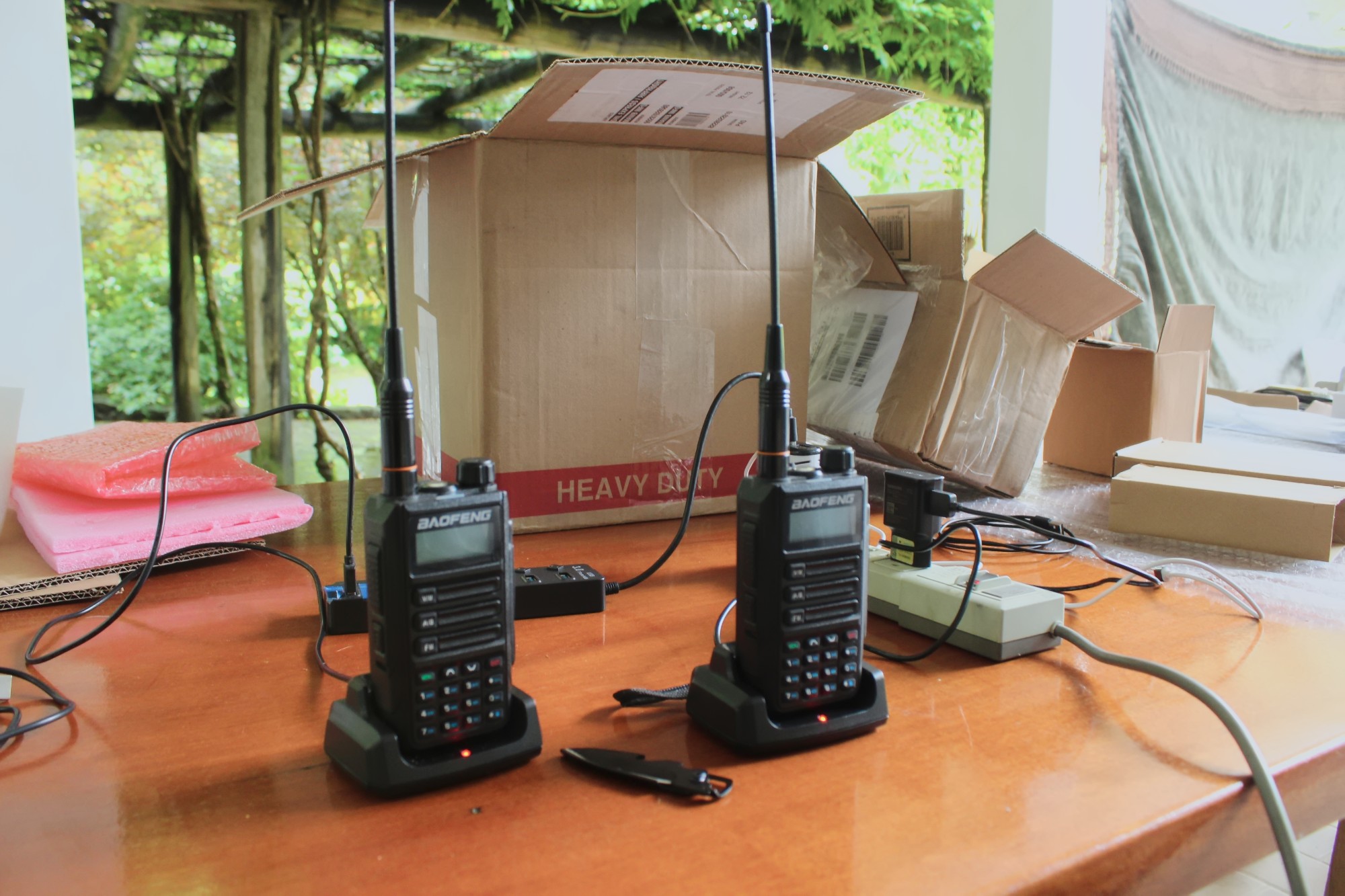
Amateur radio has its own well-known equipment brands: names like Yaesu, Icom, and Kenwood are the reference among certified operators, while cheaper radios, such as the popular Baofeng sets, have become the entry point for beginners — as long as they are configured correctly within the service’s bands and rules.
Amateur radio, identified by the PY (Amateur Radio Prefix) , offers the greatest range and technical flexibility among the three categories, in exchange for a more demanding qualification process. Operating it requires three elements: a certified operator, an authorized service, and a licensed station.
Qualification. The COER is free and obtained through an online exam, across three classes. Class C is the entry level, with a minimum age of 10 and power up to 100 W. Class B reaches 1,000 W, and Class A, 1,500 W, with access to all frequency bands.
License. The radio frequency use authorization is valid for 20 years, or 10 at the operator’s request. Renewal should be requested in Mosaico three months before it expires.
Entities. Besides individuals, civil defense agencies, universities, and nonprofit organizations can also hold a station license. In these cases, whoever is responsible for the station needs a Class A qualification.
In an emergency, the rules shift in favor of relief efforts:
- emergency communications take priority over any other traffic, and other operators must clear the frequency;
- transmitting on more than one band at the same time is allowed;
- a Repeater may transmit without a time limit;
- the National Calling Frequency on 2 meters, 146.520 MHz, serves as a reference for general calls and emergency support.
Third parties. A person without a COER can speak through the station, as long as the responsible amateur radio operator is present. This way, a community leader can relay a distress call directly through the Base, with the operator alongside them.
Type approval. Every piece of equipment used in Brazil must be certified or type-approved, including homemade equipment. Modifications that take a radio outside its approved conditions can be treated as a violation.
Who could use this channel, and how
| Group | Proposal |
|---|---|
| Tridecs strategic coordination | Longer-range communication between the Base and distant forward posts. |
| Network of volunteer amateur radio operators | Mobilizing licensed operators to support communications during an emergency, as happened in Rio Grande do Sul in 2024. |
| Civil defense and public agencies | Legal traffic priority in declared emergency situations. |
| Telecommunications teams | A coordination layer between isolated points while conventional infrastructure is being restored. |
These examples, across all three categories, are not a closed set of uses. They are part of the hypotheses Tridecs wants to test in the field, to understand in which situations each type of radio best complements LoRa, Meshtastic, and the other layers of the communication plan.
How to operate in an emergency
The procedure is the same across all three categories: listen, speak briefly, and log.
- Listen before speaking. A few seconds are enough to avoid cutting across another transmission.
- Press, wait, speak. Press the PTT , wait about a second, and speak with the radio about 5 cm from your mouth, without shouting.
- Announce priority. When there is risk to life, say “break break” or “emergency.” Anyone listening should clear the channel.
- Follow the message order. Who is calling → where they are → what happened → how many people → what is needed.
- Spell out what is hard to understand. Names and addresses, using the phonetic alphabet (Alfa, Bravo, Charlie…).
- Confirm and log. The Base records the time, who called, their position, and the situation for each contact.
An example of how this sequence sounds in practice: “Base, this is Field Post 1. X Street, near the school. House stranded, three people, one elderly. We need a boat. Over.”
Three additional precautions increase both range and autonomy:
- Height matters more than power. Climbing a few meters — a rooftop, a hill, a mast — pays off more than doubling the watts.
- Low power whenever possible. It saves battery and reduces interference.
- Scheduled check-ins. The Base calls at fixed intervals; if there is no response, the operation moves to the next layer of the PACE plan.
Why following the rules matters
Operating correctly avoids three problems: interference with other services, one of the most common causes of complaints; enforcement action for irregular operation; and risk, including reputational risk, for the operator and for the amateur radio community.
In an emergency, this matters even more: an irregular transmission can knock out the very channel someone is using to call for help.
What opportunities does this layer offer?
- Operation independent of electrical power, the internet, and mobile phone networks.
- A simple, replicable procedure that can be taught to community leaders in a short time.
- Three levels of range and regulatory requirements, which can be combined according to the needs of each point in the operation.
- Legal priority for emergency communications in the amateur radio service, including frequency clearance and unlimited repeater use.
- Low entry cost for unlicensed radios and for CB registration.
And what are the challenges?
- Qualification and registration: regular use of CB and amateur radio requires registration or certification, which means advance planning rather than something resolved in the middle of an emergency.
- Dependence on height and line of sight: terrain, vegetation, and buildings directly affect range, especially for unlicensed and CB radios.
- Diversity of equipment and rules: each category has its own band, channel plan, and technical limits, which requires extra care when configuring and distributing the radios.
- Operating discipline: the listen, speak briefly, and log procedure only works if everyone involved follows it, including under pressure.
- Power and maintenance: even low-consumption radios depend on batteries that must be sized, monitored, and, when needed, replaced throughout an operation.
- Equipment type approval: every radio in use, including homemade ones, must meet the technical conditions approved by Anatel.
What do we want to better understand through testing?
Just as we did with Wi-Fi and LoRa, we do not assume we already have all the answers about voice radio.
We want to understand how the range observed in the field varies across the three categories depending on terrain, vegetation, and antenna height; how long it takes to form and train a team able to safely operate CB and amateur radio; how to organize Mosaico registration and the COER exam ahead of an emergency, rather than during one; and how this voice procedure combines, in practice, with LoRa, Meshtastic, and the other layers of the PACE model.
With this journal, we close the cycle dedicated to the technologies behind the primary and alternate layers of our communication plan: Wi-Fi, LoRa and Meshtastic, and now voice radio. From here, Tridecs’s investigation shifts focus: instead of looking at one technology at a time, we start looking at the whole picture. The upcoming journals will cover off-grid communication, situational awareness, and SIGINT, as we work to understand how these pieces combine to sustain a disaster response from start to finish.
To dig deeper
This journal summarizes what we have investigated so far. In the project’s documentation section, organized around the Diátaxis model, you’ll find the content in reference format:
- Radio categories in Brazil and the PACE model — explanation
- Technical parameters of CB and amateur radio — reference
- How to register a CB station and get qualified for amateur radio — how-to
- How to operate the radio in an emergency — how-to
Until next time!