Throughout this series of Project Diaries, we will present the technologies we are investigating as part of a toolkit for rapid response to climate-related incidents and disasters. Our goal is not only to explain how these technologies work, but to understand how they can strengthen communication in critical moments, especially in territories where telecommunications infrastructure may have been disrupted by floods, landslides or wildfires.
When does communication become a matter of protecting life?
What happens to communication when a flood cuts off the power supply, damages infrastructure and isolates communities?
What happens when a wildfire advances over a territory and information needs to circulate quickly among firefighters, residents, support teams and humanitarian organizations?
How do people share information when part of the communications infrastructure stops working or becomes unavailable?
These questions accompany the Tridecs project, but they also stem from an earlier trajectory. Over the past few years, our work with community networks alongside quilombola communities, Indigenous peoples, forest guardians, babassu coconut breakers and other traditional communities has allowed us to observe how local communication can strengthen autonomy, territorial protection and collective organization.
But this experience also led us to a new question:
To investigate this question, we want to begin a series of tests with different wireless communication technologies that could make up a toolkit for rapid response to climate-related incidents and disasters. In this project diary, we will explore a technology that is quite well known, but not always understood in its full potential: Wi-Fi .
After all, what is Wi-Fi?
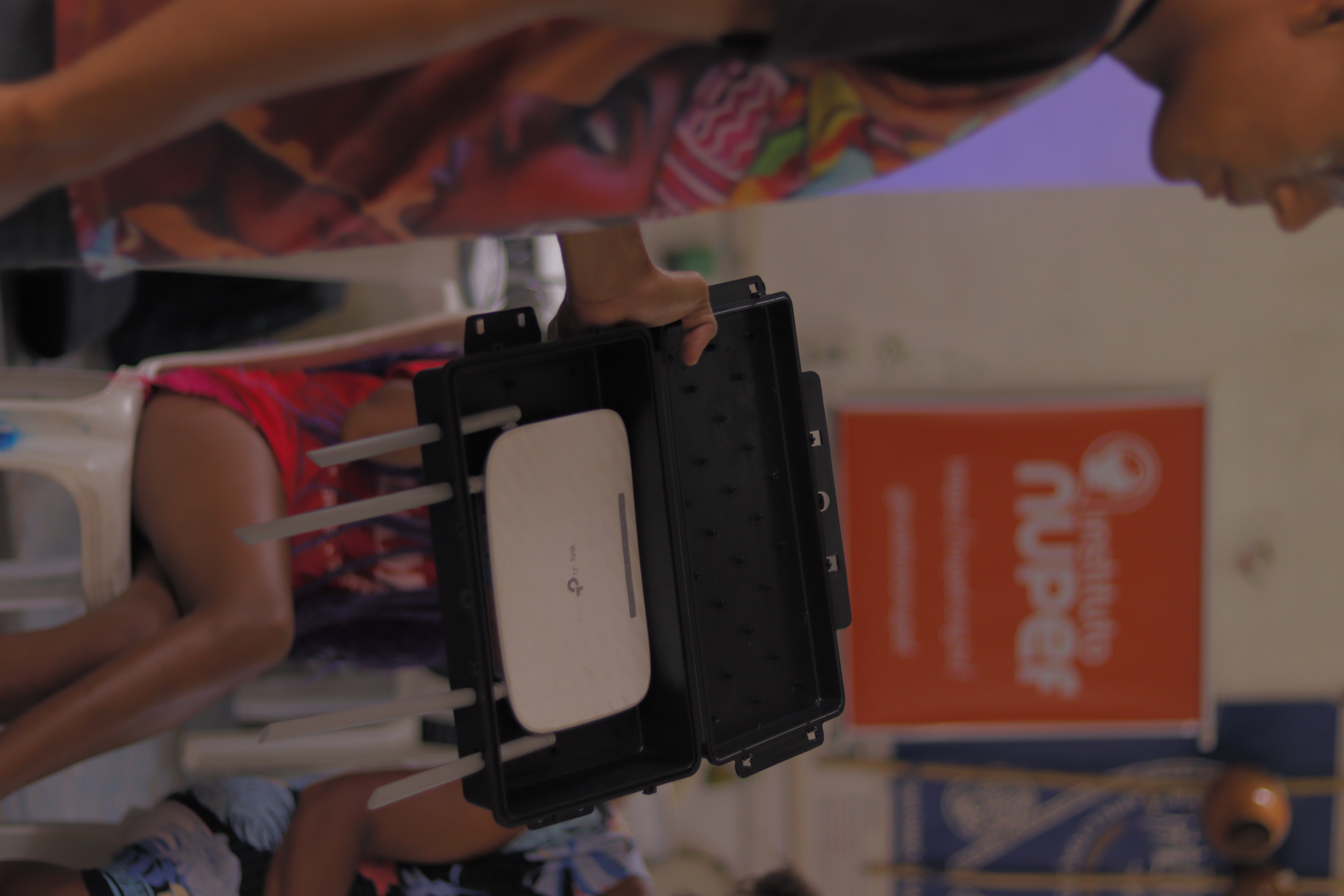
When we hear the word Wi-Fi, we usually think of the internet. But are Wi-Fi and the internet the same thing?
Actually, no.
Wi-Fi is a wireless communication technology based on a family of technical standards known as IEEE 802.11 , developed by the Institute of Electrical and Electronics Engineers (IEEE) starting in the 1990s. Over time, this family evolved through different revisions and amendments, historically identified by letters, such as 802.11a, 802.11b, 802.11g, 802.11n, 802.11ac, 802.11ax and others. Each new version sought to increase transmission speed, improve communication efficiency, expand network capacity or introduce new features. Despite these differences, they all share the same goal: allowing digital devices to exchange information using radio waves, without the need for cables.
A note on the name: throughout this text we use “Wi-Fi” in its everyday sense, to refer to local wireless networks based on the IEEE 802.11 family. Technically, the IEEE is responsible for the 802.11 standards, while Wi-Fi is a designation associated with the Wi-Fi Alliance, an organization that also maintains interoperability certification programs, such as Wi-Fi CERTIFIED.
In other words, Wi-Fi is a way of creating local wireless networks.
The internet may be connected to this network, but it is not a requirement for it to function, and this distinction is important.
When we use Wi-Fi at home, it usually serves as a bridge to the internet. However, the same set of technologies can also be used to build local networks capable of functioning even when there is no internet access.
But keeping a network running does not, by itself, mean keeping all communication services available. The network provides the paths through which devices can exchange data. To send messages, check maps, share files or access information during an internet outage, the necessary services and applications also need to be available, whether within the local network itself or through some external connection that is still accessible.
And if the internet stops working during an emergency, could a local network still be useful?
Why is Wi-Fi of interest to Tridecs?
One of the most important characteristics of Wi-Fi is its wide availability. Cell phones, laptops, tablets and various other devices already have native support for this technology. This means that, in many territories, there is already a large base of devices capable of connecting to a Wi-Fi network, reducing the need for special equipment for people to use the network. The infrastructure needed to establish and maintain this network, such as access points, network nodes, power and links between devices, still depends on the design of each deployment.
Over the past few decades, various technical communities and free culture movements have developed open tools to administer, adapt and expand Wi-Fi networks. Among them are projects such as OpenWrt , a free operating system for routers and other network devices, and LibreMesh , a set of tools based on OpenWrt created to facilitate the deployment and administration of community networks, especially mesh networks.
These initiatives allow common devices to be configured to form local communication infrastructures, managed by the communities themselves and adapted to the needs of each territory. In this context, Wi-Fi ceases to be just an internet access technology and becomes a tool for building autonomy.
Does every Wi-Fi network work the same way?
Before answering this question, it’s worth getting to know another important concept: the Topology of a network.
Topology is the name given to the way a network’s devices are organized and connected to one another. It helps us understand which connections exist between devices and through which paths information can flow, influencing the network’s ability to grow, adapt and keep working in the face of failures.
There are different types of topologies, such as star, bus, ring, tree, mesh and others. Each one has advantages and limitations, depending on the context in which it will be used. If you’d like to learn about these different forms of organization, we’ve prepared material explaining each of them in more detail in the network topology documentation.
In a simple Wi-Fi setup, like the ones found in many homes and small spaces, devices connect to an access point (AP). Often, this access point is integrated into the equipment we generically call a “Wi-Fi router”.
But what happens when this equipment fails?
Or when it becomes inaccessible?
Is there another way to organize a network?
This is where the concept of a Mesh network comes in.
What is a mesh network?
The word mesh refers to a woven, interconnected structure. In a mesh network, different devices configured as mesh nodes can collaborate to carry information across the network. Instead of all traffic depending on a single central point, these nodes can receive and forward data among themselves.
Cell phones, laptops and other devices can connect to these nodes to use the network without necessarily participating in forwarding the mesh’s traffic.
We can picture a mesh network as a web formed by several connected points. If one path is interrupted and another link is available between the nodes, the network can use an alternative route. Likewise, new nodes, when installed in suitable positions, can extend coverage and create new possible paths for communication.
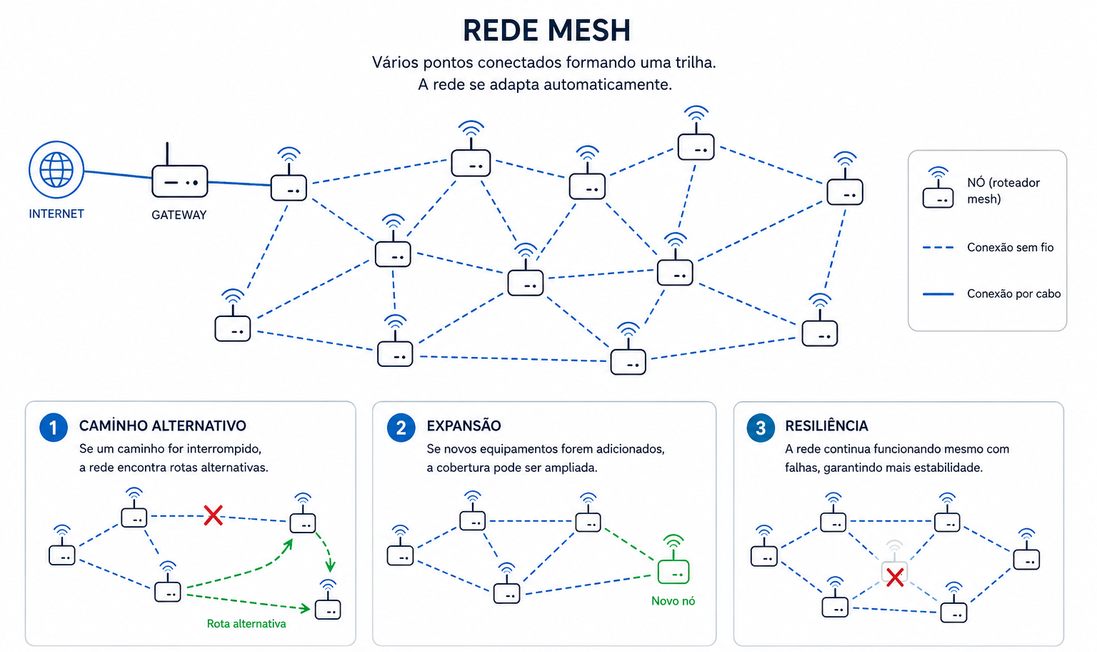
This capacity for adaptation is especially relevant in emergency situations, when part of the available infrastructure may be damaged, inaccessible or temporarily unavailable.
Free software projects such as LibreMesh use distributed mechanisms and protocols that allow nodes to exchange information about the network and select paths to forward traffic according to the conditions and metrics used by these protocols. This makes it possible to build modular, flexible networks, capable of growing gradually as new nodes are installed and integrated into the mesh.
What does this have to do with community networks?
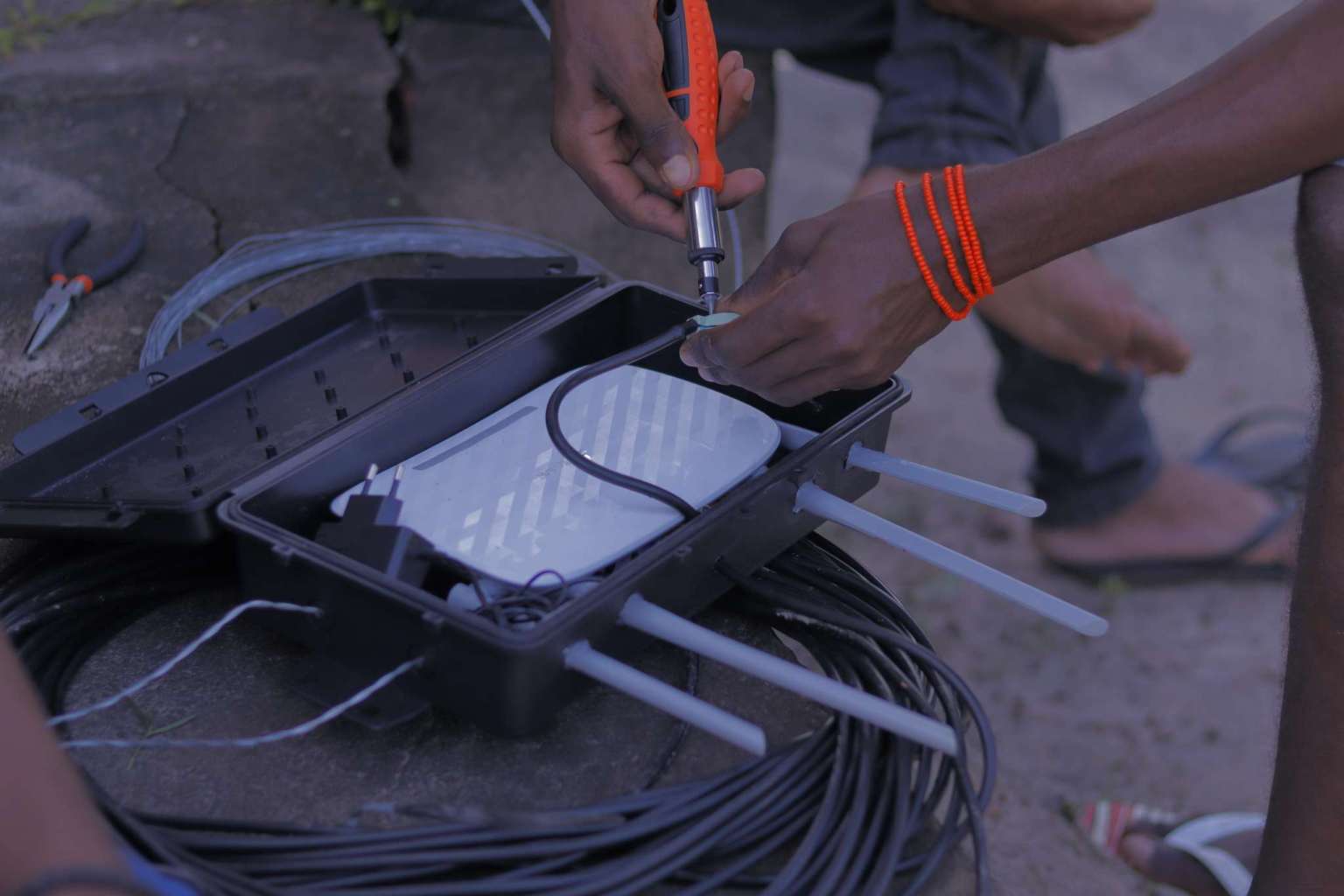
This question leads us directly to the experience accumulated by Nupef. In recent years, we have built, together with communities, processes for deploying and strengthening community networks in different territories.
These networks were created to respond to concrete challenges of connectivity, communication and territorial protection. And from this trajectory, we began to ask ourselves:
If a community network can strengthen the everyday communication of a territory, can it also contribute to communication during an emergency?
We are not talking about replacing telecom carriers, radio systems or other existing infrastructures. We are talking about creating additional layers of communication and redundancy that can increase the resilience of the territory. We are talking, therefore, about expanding communication possibilities exactly when they become most necessary.
Given this context, how could Wi-Fi be used during floods, landslides and wildfires?
There is no single answer to this question. The possibilities for using Wi-Fi depend on different factors. They vary according to the type of disaster, the conditions of the available infrastructure, the moment of the response (during the event or in the recovery phase) and the communication needs of each group involved.
A flood or a landslide, for example, can damage poles and telecommunications links and isolate communities for days or weeks. Wildfires, on the other hand, tend to create more dynamic scenarios, with constant movement of firefighting crews, rapid changes in risk areas and the need for communication across different operational fronts.
At the same time, response and rescue teams, affected communities, humanitarian organizations, telecommunications crews and public managers do not use communication in the same way. Each group produces, shares and needs different information.
It is precisely in the combination of these perspectives that a local Wi-Fi network can help strengthen a territory’s response capacity.
In the examples below, we consider not only the Wi-Fi infrastructure itself, but also the services and applications that could run on top of this network. Some could be available locally, even without internet, while others would depend on some type of external connectivity.
During floods, flooding and landslides
In these scenarios, a temporary Wi-Fi network, or one based on already existing community infrastructure, can support local communication even when part of the conventional infrastructure is unavailable.
| Group | Possible applications |
|---|---|
| Response and Rescue Teams | Can facilitate the sharing of maps, photographs, the location of flooded areas, accessible routes and information about isolated people. |
| Affected communities | Can provide access to communication and information services available on the network to locate family members, check information about shelters and supply distribution points, request help or share verified information with other people in the community. |
| Humanitarian aid organizations | Can support the registration of needs, the coordination of supply distribution, tracking of assisted families and the exchange of information between different institutions. |
| Telecommunications crews | Can serve as temporary support infrastructure for damage assessment, connectivity testing and the gradual restoration of communication services. |
In the coordination among all these groups, a local network equipped with suitable servers and applications can host shared information systems, situation dashboards, collaborative maps and other local services, contributing to a shared understanding of the scenario and reducing the circulation of conflicting information.
During wildfires
Wildfires present different challenges. Operating areas can change quickly, firefighting crews work distributed across different fronts, and the operational situation can change within minutes. In these cases, Wi-Fi can be used mainly at temporary support points, operational bases, command centers, shelters or threatened communities, allowing the exchange of information among people and equipment present in the same area.
| Group | Possible applications |
|---|---|
| Firefighting crews and response teams | The network can support the circulation of maps, images, records of firefighting fronts, operations planning and communication between bases when links capable of connecting them to the same network infrastructure are available. |
| Impacted communities | Can be used to share safety guidance, inform evacuation routes, register needs and maintain communication channels among displaced residents. |
| Humanitarian aid organizations | Can facilitate the coordination of temporary shelters, tracking of assisted people and the sharing of information between different teams. |
| Telecommunications crews | Can support the deployment of provisional communication infrastructure while conventional systems are restored or repositioned. |
In this coordination, a local network can integrate information produced by different teams, enabling a more coordinated response adapted to the rapid evolution of the fire.
These examples do not represent a closed set of applications. On the contrary, they are part of the hypotheses we intend to investigate throughout this phase 2 of the project. Our goal, therefore, is to understand in which situations Wi-Fi can complement other communication technologies, what limitations arise in the field and how these solutions can be adapted to the different realities of the territories.
What opportunities does this technology offer?
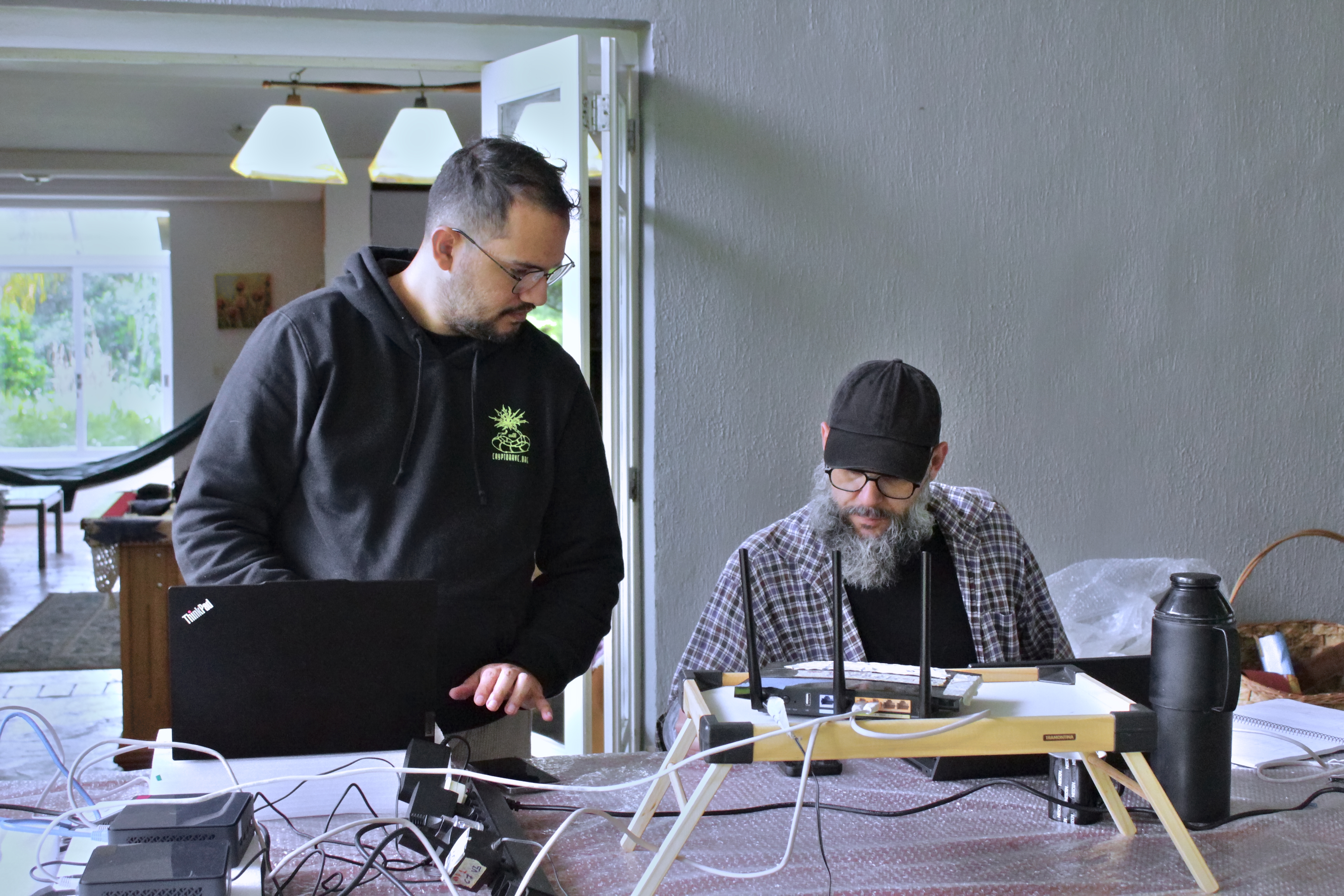
Wi-Fi has some characteristics that make it particularly interesting for experimentation in Tridecs testing contexts. Among them, we can highlight:
- Wide presence of compatible devices and availability of network equipment;
- Compatibility with common cell phones and computers;
- Relatively low costs in many scenarios;
- Possibility of relatively fast deployment and expansion;
- Possibility of operating in local networks without internet;
- Integration with open source software solutions;
- Possibility of building community mesh networks;
- Possibility of reusing infrastructure that already exists in the territories.
These characteristics make it possible to imagine modular systems that can be transported, installed and adapted according to the needs of each context.
And what are the challenges?
No technology solves every problem. Wi-Fi also has important limitations, for example:
- Its range is relatively limited when compared to other wireless communication technologies.
- The infrastructure depends on power sources.
- Equipment can be damaged by floods, landslides, smoke, intense heat or falling trees.
- In addition, building and maintaining networks requires planning, technical training and local organization.
However, these challenges do not diminish the technology’s potential. They help define which questions need to be answered during the tests, in order to understand when and where it can be a component of a toolkit.
What do we want to better understand through the tests?
Tridecs does not start from the idea that we already have all the answers. We are investigating possibilities. We want to understand how open technologies and community infrastructures can help expand territories’ response capacity in the face of floods, landslides and wildfires.
That is, we want to understand which solutions work best, what limitations appear in practice, what knowledge needs to be shared and what tools can be incorporated into a rapid response kit built on the principles of resilient infrastructures and free technologies.
In upcoming diaries, we will explore other technologies that are also part of this investigation, such as LoRa and HT Radio , seeking to understand how different tools can work in a complementary way to build more resilient communication systems for emergency situations. Until next time!