Introduction
The Meshtastic ecosystem is formed by the relationship between hardware, firmware, radio, power, and configuration tools. More than a specific app or board, it is a distributed communication infrastructure based on mesh networks and LoRa radio.
Understanding these layers, even at a basic level, helps a lot during installation, update, maintenance, and experimentation processes. Many of the difficulties encountered day to day are not related only to the firmware or the hardware in isolation, but to how these parts interact.
In simplified terms:
- the hardware provides the physical components;
- the firmware organizes how the network operates;
- apps and web environments allow devices to be configured, monitored, and updated.
The hardware provides the radio, antenna, battery, sensors, USB ports, and physical interfaces. The firmware coordinates how all of this works together, managing tasks such as:
- message relaying;
- mesh routing;
- power management;
- radio synchronization;
- persistence of settings;
- end-to-end encryption.
Much of this complexity happens in the background while the network is running. This is what allows different boards to operate together using the same communication protocols.
Where does this hardware come from
Most of the devices used in Meshtastic originally emerged in IoT (Internet of Things) contexts. These are boards designed to transmit small amounts of data using little power while reaching long distances.
These characteristics ended up making this type of hardware attractive for community mesh networks, local experimentation, and autonomous communication infrastructure.
Today there are different architectures compatible with Meshtastic, including:
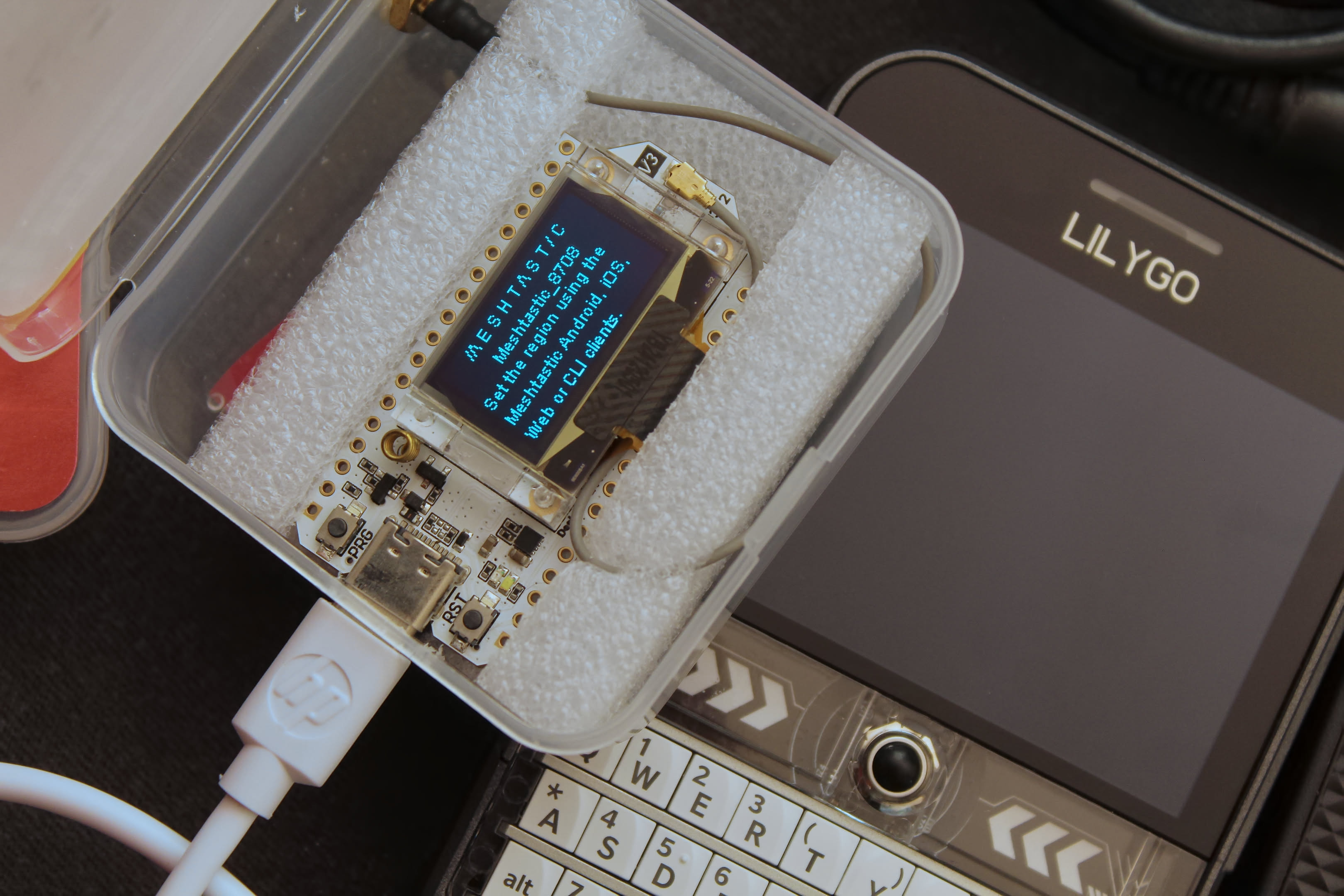
- ESP32, very common in boards from LILYGO, Heltec, and Seeed Studio;
- nRF52, widely used by RAK Wireless in low-power devices;
- RP2040, found in some platforms derived from the Raspberry Pi Pico.
Even with differences between manufacturers and architectures, these devices usually share similar elements:
- LoRa radios;
- battery management;
- USB communication;
- sensor support;
- GPS modules;
- OLED or E-ink screens on some models.
This relative standardization allows different devices to take part in the same mesh network.
The role of LoRa
The technical core of the ecosystem is LoRa technology.
Unlike Wi-Fi or mobile networks, LoRa was not created to transmit large volumes of data quickly. Its main purpose is to enable long-distance communication using little power.
This directly influences how the mesh network works:
- messages are small;
- transmissions happen at low speed;
- power consumption is reduced;
- retransmissions need to be controlled;
- OTA updates have limitations.
In Brazil, ISM bands in the 915 MHz range are normally used, allowing operation without direct dependence on commercial carriers.
These technical limitations and characteristics shape both the firmware’s behavior and the mesh network’s own architecture.
Different device formats
The Meshtastic ecosystem includes everything from open boards for experimentation to devices that are practically ready to use.
There is equipment that is:
- compact and portable;
- prepared for outdoor use;
- aimed at fixed repeaters;
- adapted for external sensors;
- designed for low power consumption.
There are also important differences related to antenna quality, power management, physical interfaces, and expansion capacity.
Currently, much of the community experimentation happens on ESP32 platforms, especially devices from LILYGO, Heltec, and Seeed Studio, due to their availability and ease of access.
Firmware as the network’s system
Meshtastic firmware works as the layer that coordinates hardware, radio, and the mesh network.
Each board requires a specific build because the firmware needs to know concrete details about the hardware:
- radio used;
- battery management;
- pinout;
- USB ports;
- sensors;
- screen interfaces.
Because of this, using an incompatible build can prevent the device from working correctly.
The project also maintains different firmware distribution channels:
- Stable → the most stable versions;
- Beta → versions with recent features being validated;
- Alpha → experimental versions.
These updates aren’t just for fixing problems. They also change how the network works, improve routing algorithms, expand compatibility, and add support for new hardware.
Updating as infrastructure maintenance
Updating Meshtastic devices doesn’t just mean installing a new software version.
In practice, updates help keep the entire network infrastructure running in a more stable and compatible way.
New versions can:
- improve routing;
- fix security flaws;
- optimize power consumption;
- expand compatibility between nodes;
- add support for recent sensors and modules.
At the same time, there are important physical limits. Some older devices may stop supporting recent features due to available memory, power limitations, or processing capacity.
Understanding these relationships helps us see updates as part of the ongoing maintenance of the mesh network itself.
Further reading
After understanding how hardware, firmware, and radio relate within the ecosystem, the next step is to learn about the practical update methods.