How can communication be maintained in emergency situations caused by climate disasters? That is the question that drove the development of the project “Technologies for Rapid Response to Climate Incidents and Disasters - Tridecs”.
Divided into three stages, the project aims to research and develop maps of technological solutions for scenarios in which conventional communication systems and uses fail. The proposal is to map, test, and adopt viable alternatives so that communication is not interrupted, even under the worst circumstances.
The priority audience is social movements, activists, environmental defenders, and public and private institutions active in incident situations, among other actors who live and work where there is a need for rapid response to climate disasters caused by the climate emergency.
What Tridecs aims to do
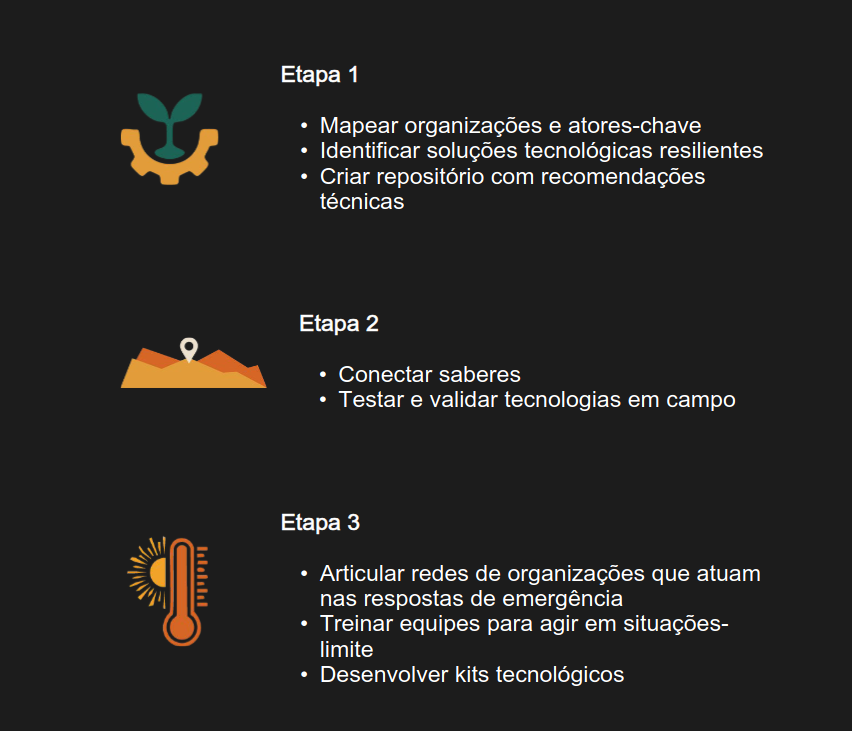
In the first phase, technologies in general will be mapped and evaluated, and the most resilient ones — low-cost, autonomous, and adaptable — will be selected, such as variations of radio, cable, and light spectrum. The main actors involved in rapid response will also be identified, and the most suitable technologies for each type of climate disaster will be analyzed, resulting in the creation of a repository with information and technical content offering recommendations on different types of technologies and the climate disasters in which they can be used.
In the following stages, the technologies identified as having potential use will be tested on the bench and in the field, and once validated, training will be carried out to form teams prepared to act in extreme situations.
The project will be implemented on a pilot basis in two Brazilian states: Rio Grande do Sul (South region) and Maranhão (Northeast region), isolating their specific types of climate disasters and regional characteristics. In the long term, the plan is to create trained teams equipped with a technology kit offering specific recommendations for different types of climate disasters.
The first phase of the project began in February, carried out by Nupef with support from the Digital Access Programme of the Embassy of the United Kingdom in Brazil, and ran until February 2026. The project is currently in its second phase, maintaining the same institutional support.
Who we are
Nupef is a civil society organization that began its journey in 2005. We promote the safe use of technologies to guarantee rights and contribute to the full exercise of citizenship. We organize our work around two main programmatic areas: Right to Connectivity and Territorial Protection, and Resilient Infrastructure and Information Security.
Who makes Tridecs happen
Coordination Core: Joara Marchezini, Moacir Neto, and Zeilane Fernandes
Communications Coordination: Bruna Hercog
Supervision: Oona Castro and Rodrigo Troian
Research Team: Joara Marchezini, Carol Magalhães, Vitória Santos, Zeilane Fernandes, Moacir Neto, Flávio Hernan, Rodrigo Troian
Design and social media management: Isabella Selaimen
Hotsite development: Zeilane Fernandes
Review: Renato Racin
Learn about other Nupef projects by visiting the website nupef.org.br.